What Shapes the Ride
A roller coaster is a gravity-fed machine governed by strict physical laws. Every dip, banking transition, and inversion exists to balance adrenaline against the structural tolerance of the human spine.
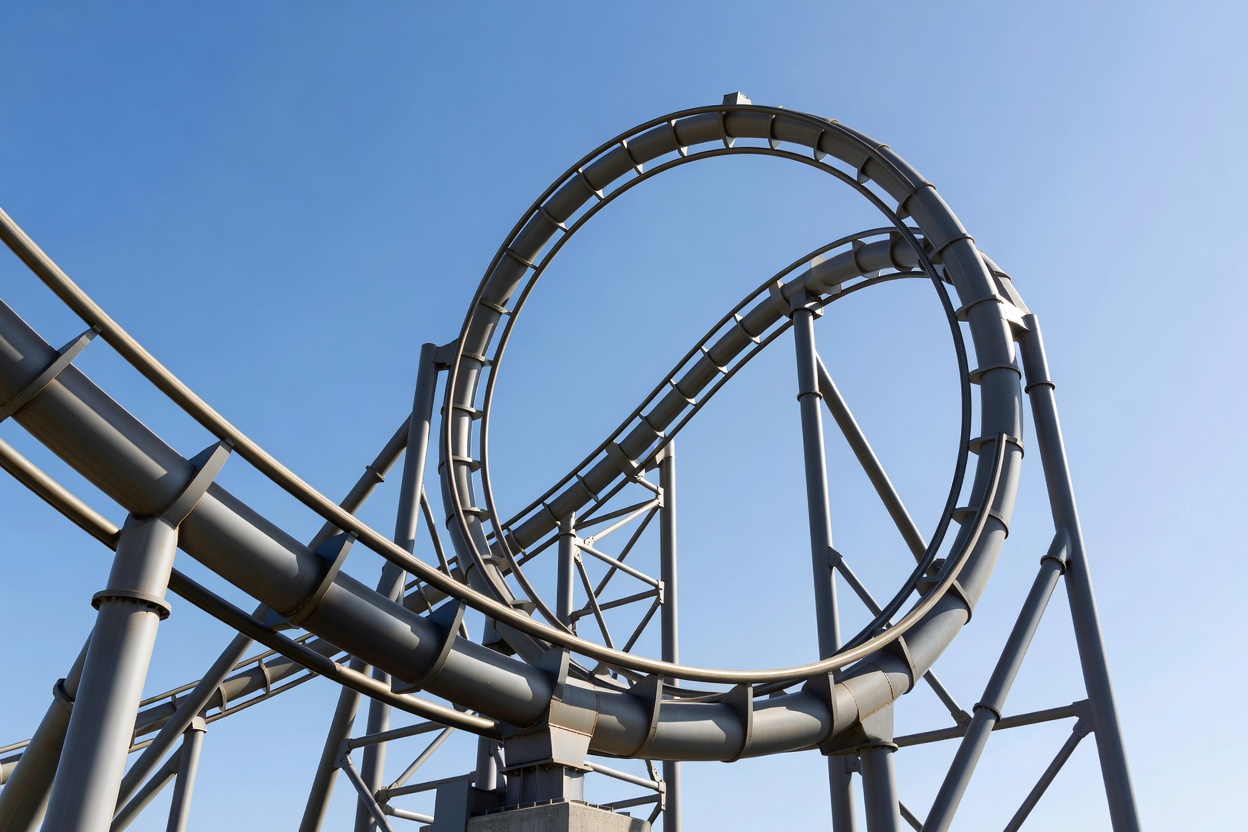
The Clothoid Loop Revolution
Early 20th-century coasters attempted circular inversions, producing dangerous 12-G neck loads. In 1976, Anton Schwarzkopf and Werner Stengel introduced the clothoid teardrop loop to modern parks:
- Variable Radius: Entering the loop through a gentle large radius reduces immediate vertical G-forces.
- Tight Apex: The tighter curvature at the crown maintains rider momentum and prevents stalling upside down.
Mechanical Systems Breakdown
Chain Lifts, LIMs, and Hydraulic Winches
Traditional lift hills rely on an endless steel chain driven by high-torque electric motors, equipped with continuous anti-rollback ratchets (the iconic clicking sound). Modern high-intensity coasters frequently employ Linear Synchronous Motors (LSM), using electromagnets in the track to push and pull magnetic arrays mounted underneath each train car, accelerating from standstill to 100 km/h in under two seconds without mechanical friction.
Block System & Eddy Current Retarders
A coaster layout is subdivided into distinct block sections: the station, lift hill, mid-course brake run, and final brake run. Fail-safe pneumatic block brakes held closed by mechanical springs remain clamped shut unless electric solenoids actively pump compressed air to open them. If downstream optical sensors detect a train still occupied in the next block, the incoming train is automatically halted.
Wood, Tubular Steel, and Hybrid I-Box
Traditional wooden roller coasters flex under load, dispersing mechanical energy into thousands of treated yellow-pine timbers. Modern tubular steel rails (introduced by Arrow Dynamics in 1959) allow complex barrel rolls. In recent years, Rocky Mountain Construction (RMC) developed steel box tracks that replace wooden running rails on aging trestles, enabling inversions and extreme 90-degree drops on classic wooden frameworks.
Understanding Rider G-Forces
Ride engineers must manage acceleration along three orthogonal spatial axes:
The Pull-Up
Occurs at the bottom of steep drops and tight pull-ups. Forces blood toward the feet. Safe modern coasters limit this to 4.0G–4.5G for durations under 3 seconds to prevent visual greyouts.
The Parabolic Crest
The exhilarating sensation of weightlessness when cresting a camelback hill. Floater airtime hovers near 0.0G, while intense ejector airtime reaches -1.0G, pushing riders firmly against lap bars.
The Sideways Push
Forces pulling the torso side to side. Because the human neck is vulnerable to lateral whipping, engineers bank curves up to 85 degrees to redirect lateral energy down through the seat as positive vertical force.
The Legacy of Ing.-Büro Stengel
Founded by Dr. Werner Stengel in Munich in 1965, the engineering consultancy has calculated the layout and heartline mathematics for over 600 iconic roller coasters globally, including legendary designs for manufacturers like Intamin, Mack Rides, and Bolliger & Mabillard (B&M). Their early work on the computerization of coaster rail curves transformed fairground thrill rides into high-precision structural feats.