Inside the Illusion
Themed entertainment transforms industrial warehouse structures into mysterious temples, deep oceans, and forgotten villages through precise lighting isolation, forced scale, and physical optical effects.
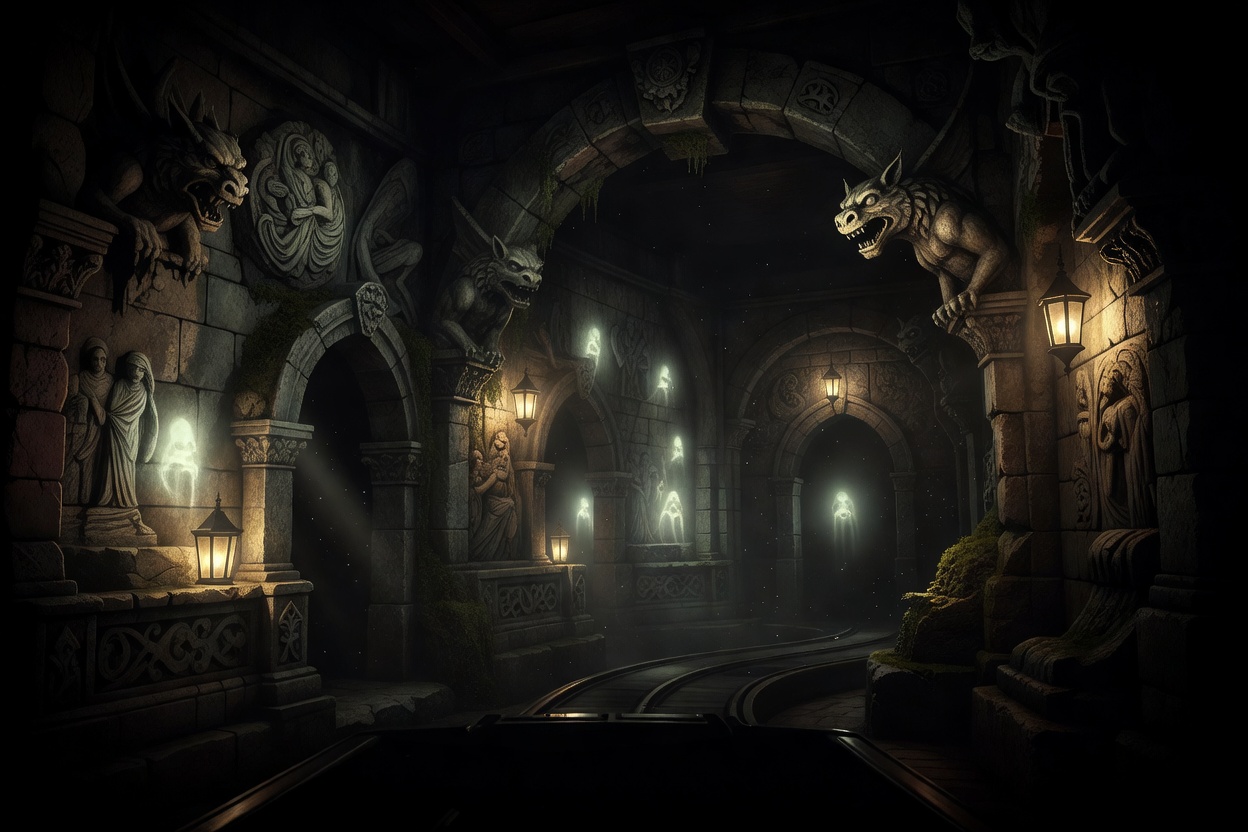
The Art of Complete Sensory Isolation
Behind the ornate medieval or futuristic facades lies an unremarkable steel portal frame structure known to engineers as a show box or gravity shed:
- Light Baffles: Light locks (zigzag corridors) at vehicle ingress and egress points prevent blinding outdoor sunlight from washing out delicate scene lighting.
- Acoustic Damping: Fiber batting on warehouse ceilings absorbs echoing chatter and mechanical squeaks.
Enduring Practical Visual Tricks
While digital screens are increasingly common, classic practical physical effects retain a depth and permanence that projection alone cannot replicate.
| Technique | Underlying Principle | Historic Origin | How Visitors Experience It |
|---|---|---|---|
| Pepper's Ghost | Beam-splitter reflection off giant angled glass plate | John Henry Pepper & Henry Dircks (1862) | Translucent phantom figures sit, play organs, or dance seamlessly inside physical solid rooms. |
| Forced Perspective | Diminishing scale on vertical architectural planes | Renaissance scenic design / Cinecittà studios | A 15-meter castle or mountain appears to stand 60 meters tall against painted atmospheric sky backdrops. |
| Blacklight (UV) Luminescence | Near-ultraviolet radiation exciting zinc sulfide pigments | Robert & Joseph Switzer (1930s) | Fluorescent artwork glows brightly while tracks, supports, and ceilings remain invisible in darkness. |
| Pneumatic Animatronics | Compressed air valves triggering rapid linear piston strokes | 1960s theme park engineering | Life-sized sculpted figures speak and gesture smoothly without visible human operators. |
Directional Sound & Audio Zones
Sound spill can break visitor immersion instantly. If the dramatic music of an exploding volcano bleeds into a quiet fairy-tale forest ten meters away, the illusion collapses.
Parabolic Dome Speakers
Narrow-beam transducers focus audio into tight sound columns. A visitor standing beneath a lamppost hears an intimate whisper, while someone standing just two paces to the side hears only ambient wind.
On-Board Vehicle Audio
By mounting speakers directly behind rider headrests, show engineers synchronize soundtrack crescendos to exact vehicle coordinates regardless of whether a vehicle is moving at top speed or paused in a block zone.
Sub-Bass Transducers
Tactile bass shakers bolted directly to vehicle chassis vibrate the seats during simulated thunder or monster stomps, providing visceral impact without deafening auditory decibel levels.
The Principle of Seamless Transitions
Master designers like John Hench (Disney) and Ton van de Ven (Efteling) understood that immersion depends on smooth transitions. Cobblestone paths do not abruptly end at wooden floorboards; instead, loose cobbles gradually merge into weathered timbers. These subtle gradient transitions reassure the visitor's subconscious mind, allowing full surrender to the story.